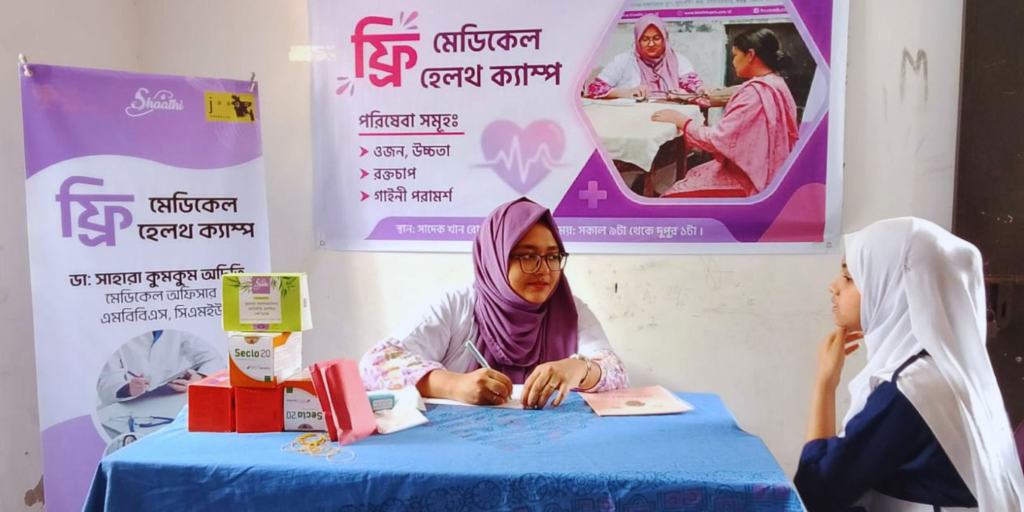
Breaking Stigma in Rayer Bazar, Dhaka, a six-month initiative has quietly demonstrated something powerful: when communities lead their own conversations about menstrual health, lasting change follows. By weaving together household visits, school programs, and healthcare partnerships, the Shaathi Foundation supported by The Khan Foundation and managed by the JAAGO Foundation has shown a blueprint for how urban Bangladesh can normalize menstrual health discussions with dignity and knowledge.
Quick Impact Overview
| Metric | Result |
| Project duration | 6 months |
| Households visited | 5,595+ |
| People reached | 5,000+ |
| Materials distributed | 7,000+ |
| Student peer educators trained | 22 |
| Courtyard sessions | 21 |
| School programmes | 11 |
| Parents’ meetings | 9 |
| Community health camps | 2 |
A Strategy Rooted in Trust and Presence
The project’s success wasn’t accidental it was built on a phased strategy grounded in understanding local needs. Shaathi’s team began with a comprehensive baseline assessment and pilot testing, then systematically expanded outreach through multiple channels: door-to-door household visits, courtyard discussions, school awareness programmes, parents’ meetings, community health camps, and dedicated sessions with healthcare providers. An endline evaluation completed the circle.
Over 80 working days, community educators knocked on more than 5,595 doors and distributed over 7,000 educational materials. More importantly, they reached over 5,000 individuals women, adolescent girls, parents, teachers, healthcare workers, and community leaders creating a movement rather than a program.
Embedding Change in Schools
Sustainability was woven into the project from the start. Twenty-two student volunteers were trained as peer educators, transforming them from participants into advocates. These young leaders are positioned to sustain conversations about menstrual health within their schools and peer networks long after the project concludes a multiplier effect that extends the initiative’s reach indefinitely.
Beyond immediate impact, the project identified concrete pathways forward: establishing school-based pad banks and creating infrastructure for ongoing community engagement. These steps ensure menstrual hygiene management remains part of the normal conversation in schools and communities, not a one-time intervention.
What the Numbers Reveal
Monitoring and evaluation painted an encouraging picture. Participants showed measurable gains across key outcomes:
- Greater confidence in open discussion about menstruation
- Improved knowledge of menstrual hygiene management practices
- Growing acceptance of reusable sanitary pads as viable alternatives
These results underline a critical insight: repeated, trusted engagement works. The project’s strength lay not in top-down messaging, but in involving entire families and tapping into respected local facilitators. The collaboration between schools, healthcare providers, and community institutions proved essential to converting awareness into actual behavior change.
Bridging Healthcare Systems with Community Voice
A pivotal strength of the initiative was its deliberate integration with local healthcare providers and public health infrastructure. By conducting dedicated sessions with healthcare workers and community health volunteers, the project ensured that menstrual health was embedded within the broader primary healthcare landscape. These partnerships enabled healthcare providers to address misconceptions they frequently encountered and to position themselves as trusted resources for menstrual-related concerns. The project also sensitized healthcare workers to the psychosocial dimensions of menstrual health understanding that many women and girls delayed seeking care due to embarrassment or shame. This human-centered approach transformed clinics and community health camps from transactional spaces into inclusive environments where menstrual concerns could be addressed with compassion and evidence-based guidance.

Sustainability Beyond the Project Cycle
The true measure of community-led initiatives lies in their ability to persist after external support concludes. This project laid groundwork for long-term sustainability through institutional partnerships, trained local volunteers, and documented best practices that can guide future efforts. Schools now have frameworks for continuous peer education, parents have internalized healthier conversations, and communities possess the knowledge and confidence to address menstrual health challenges independently. By investing in local capacity rather than external expertise, the initiative created conditions for organic, self-sustaining change a model far more resilient than conventional awareness campaigns.
A Replicable Model for Urban Bangladesh
Shaathi Foundation’s Rayer Bazar initiative offers more than a success story it provides a tested, adaptable framework. Similar approaches can be tailored for other underserved urban and peri-urban communities by thoughtfully bridging household education, schools, healthcare systems, and local leadership.
With sustained investment and cross-sector collaboration, these models can catalyze progress across interconnected challenges: menstrual health and hygiene, educational participation and retention, gender equality, environmental sustainability, and broader community well-being.
The lesson is clear: consistent, hyper-local engagement isn’t a nice-to-have feature of community development it’s essential. It’s the difference between raising awareness and driving the kind of dignified, knowledgeable conversation about menstrual health at communities deserve.