The Bengali word para is untranslatable in its fullness. To an outsider, it is a neighborhood; to a local, it is a living organism. It is defined by adda (the art of long, rambling conversation), shared walls, and the unspoken security of a common tongue.
When the South Asian diaspora moved west, they didn’t just bring spices in their suitcases; they brought the blueprint of the para. In the face of cold climates and colder social receptions, they turned concrete streets into cultural anchors. Today, these six neighborhoods are more than commercial hubs—they are monuments to resilience and the refusal to be erased.
⚡ Fast Facts: Global South Asian Diaspora Neighborhoods
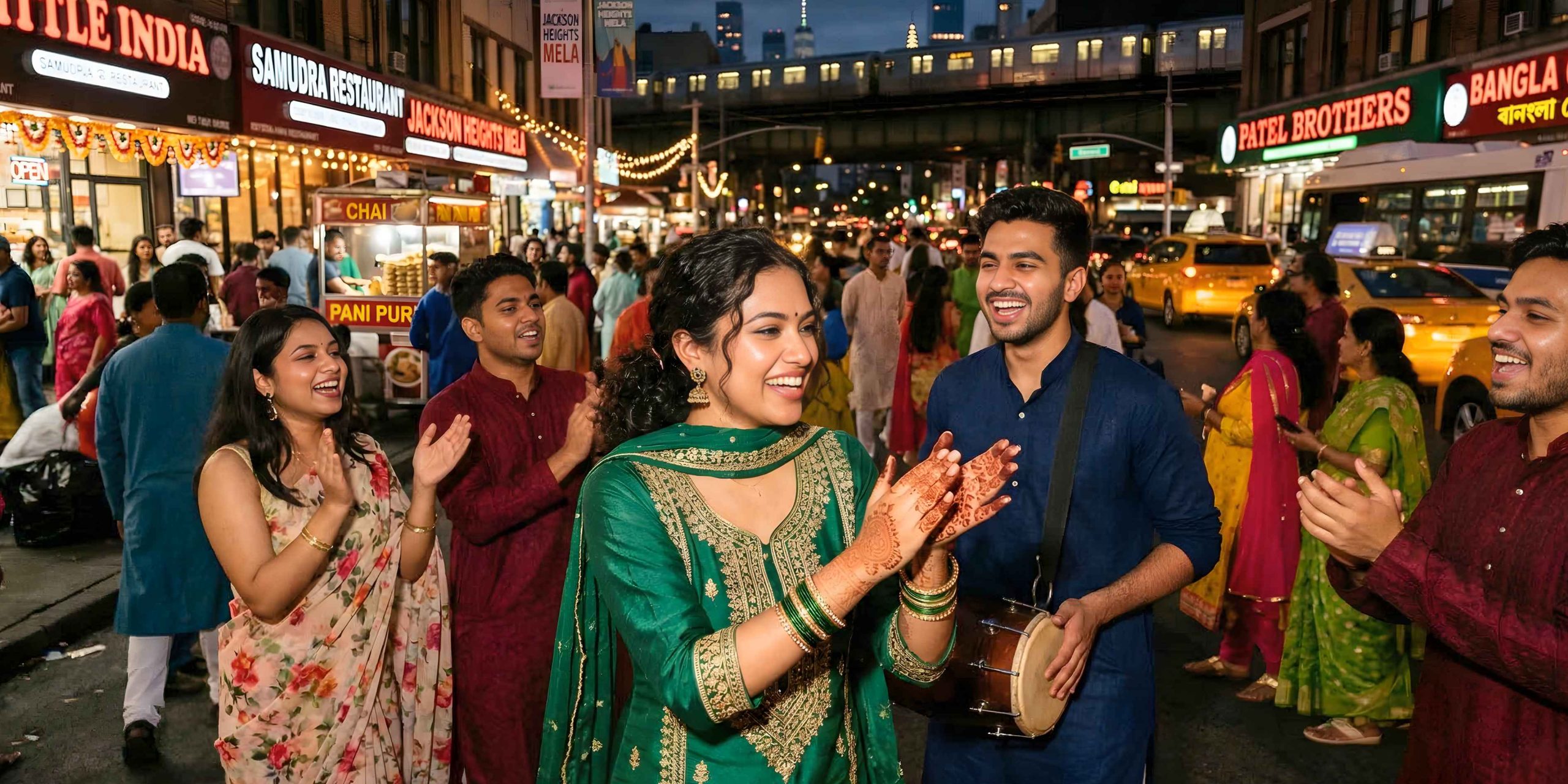
Jackson Heights was originally designed in the early 1900s as a “garden city” for the white middle class—a suburban escape within the city. But history had other plans. Following the 1965 Immigration Act, a wave of South Asian professionals arrived, followed by the “working-class pioneers” of the 70s and 80s.
The History: It began with a single shop called Sam and Rajin 1976. Today, it is a microcosm of the subcontinent.
The Vibe: Under the rattle of the 7 train, you find the para in its most chaotic, beautiful form. It is the only place in the world where you can hear Tibetan, Bengali, and Punjabi within a ten-foot radius. It isn’t just “Little India”; it is a Himalayan-Andean-South Asian fusion that proves the para can adapt to any skyline.
Jackson Heights South Asian Business District Queens New York
Brick Lane is a palimpsest of migration. It was a haven for Huguenots, then Irish weavers, then Ashkenazi Jews, before becoming the spiritual home of the Sylheti community.
The History: The “Banglatown” we see today was a political victory, born out of the 1970s struggle against far-right violence. The para here was forged in defense of the community.
The Vibe: To walk Brick Lane is to smell the history of the merchant navy. Many of the first settlers were lascars (sailors) who jumped ship to find work in the East End. Today, the Baishakhi Mela here is Europe’s largest celebration of Bengali culture—a poignant stand against the gentrification threatening its edges.
Brick Lane Banglatown London South Asian Cultural District
Unlike the dense urban grids of New York or London, Brampton represents the “suburban para.” Here, the Punjabi diaspora has achieved something rare: political and cultural density.
The History: Since the late 20th century, Brampton has become the heartbeat of the Canadian Sikh community. It’s no longer an “enclave”; it is a powerhouse that dictates national policy and shapes the global Bhangra scene.
The Vibe: Here, the para is found in the sprawling Gurdwaras and the shared driveways. It’s a place where the “Canadian Dream” is spoken in Punjabi, and the local grocery store is as large as a stadium.
Brampton Ontario South Asian Diaspora Community Streetscape
4. Southall, London: The “Little Punjab” of the West
If Brick Lane is the soul of the East, Southall is the engine of the West. It rose from the post-WWII labor shortages when South Asians arrived to work at Heathrow Airport and nearby factories.
The History: Southall’s identity was cemented by the Sikh community, who built some of the largest Gurdwaras outside of India.
The Vibe:Southall Broadway is a sensory overload. It feels less like London and more like a high street in Ludhiana. The para here is defined by the Nagar Kirtan (processions) that turn the streets into a sea of saffron and blue.
Southall London Little India South Asian Cultural District
5. Gerrard India Bazaar, Toronto: The Cinema that Built a Street
Established in the 1970s, this is one of North America’s oldest South Asian commercial districts. Interestingly, it never became a major residential center, but rather an “economic para.”
The History: It started with the Naaz Theatre in 1972, which showed Bollywood films. People traveled from all over Ontario to see a movie, and shops naturally sprouted around the theater to serve them.
The Vibe: While facing heavy gentrification today, the “Bazaar” remains a site of memory. It represents the era when South Asians had to cross cities just to find a specific spice or a VHS of a Rekha film.
Gerrard India Bazaar Toronto South Asian Cultural District
6. Artesia “Little India”, California: The Symbolic Home
Artesia is a unique case where a small Portuguese dairy farming town was transformed by the 1965 immigration wave.
The History: Unlike the other hubs, Indians make up less than 5% of the town’s residents, but they own the vast majority of the businesses. It is a “destination para” for the millions of South Asians in Southern California.
The Vibe: On weekends, Pioneer Blvd becomes a pilgrimage site. It proves that a para doesn’t always need people living in it to be “home”—it just needs the shared rituals of jewelry shopping and Sunday thalis.
Artesia Little India California South Asian Shopping District
🌍 Why the Global Para Matters
These neighborhoods are not just “ethnic enclaves”—they are vessels of cultural continuity. In a world that often asks immigrants to blend in, the para allows them to stand out. They are sites of political mobilization, economic power, and, most importantly, places where the next generation can touch their roots without needing a passport.
From the curry houses of the East End to the sari shops of Queens, the para isn’t just a place. It’s the feeling of finally being able to exhale.
🔗 Explore More on TINDS News
From culture to business to global headlines — dive deeper into the stories shaping our community. Discover more at Tinds.com ✨